

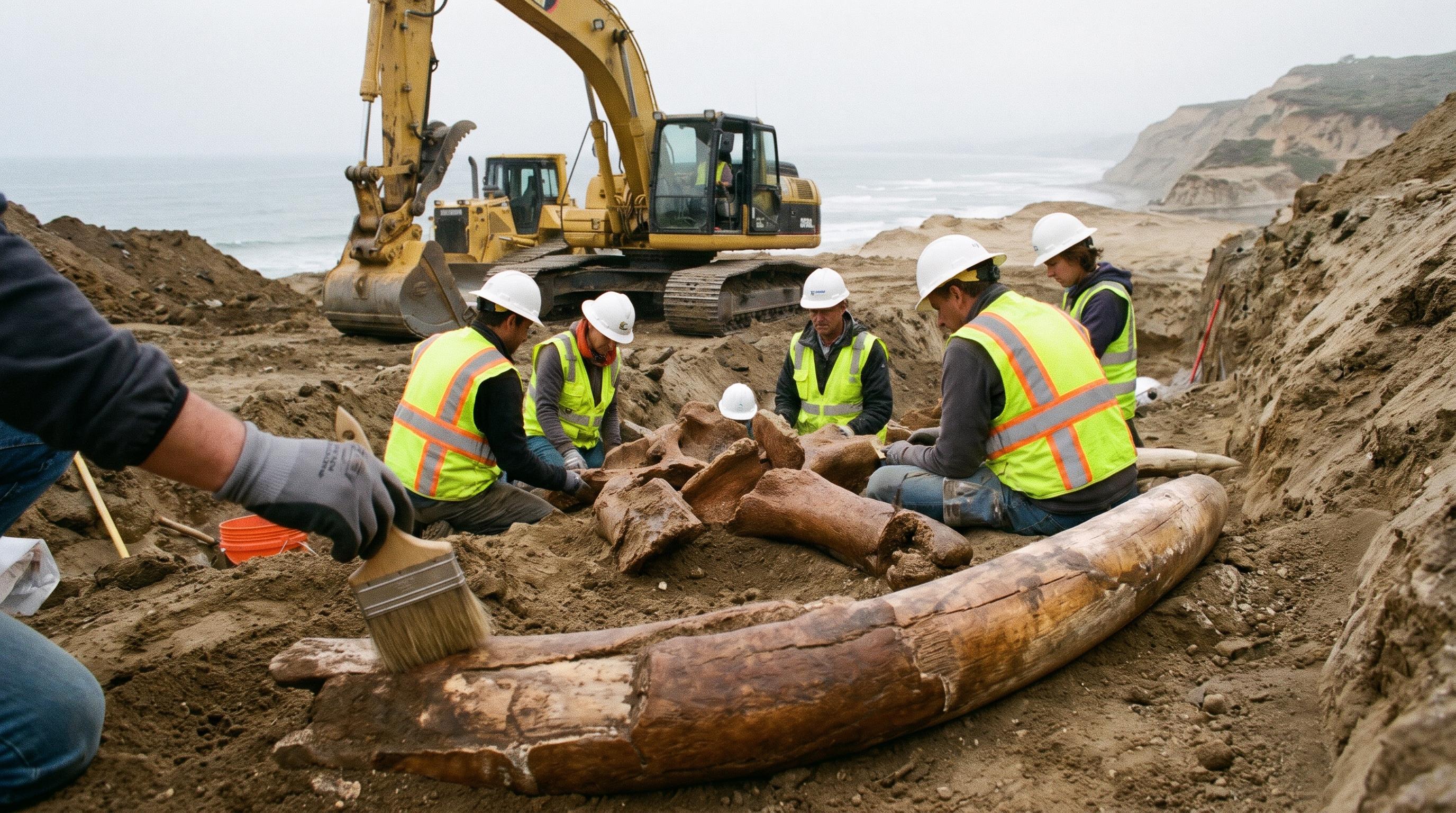
A construction crew in Oceanside recently unearthed bones from a large mammal estimated to be 40 to 45 million years old, offering a rare glimpse into the deep past of San Diego County. The significant paleontological discovery, found approximately 12 feet below the surface at an undisclosed construction site, provides compelling evidence of an ancient ecosystem that once thrived in the Oceanside region. For local residents, this find underscores the rich, hidden history beneath their feet and highlights the unexpected scientific contributions that can emerge from routine infrastructure development within the community.
The fossilized remains date back to the Eocene Epoch, a geological period spanning from approximately 56 million to 34 million years ago, when Earth's climate and animal communities were vastly different from today. Joseph El Adli, a principal paleontologist with Helix Environmental Planning, identified the fossil bones while monitoring the construction work, according to recent reports. The discovery occurred during excavation work in Oceanside, with the City of Oceanside officially announcing the find on September 22, 2026.
The recovered material includes several limb bones, ribs, and numerous additional bones and fragments. Other reports also describe the find as encompassing a skull, numerous limbs, and larger ribs. These specimens were embedded in compacted mudstone and sandstone, requiring paleontologists to carefully remove the surrounding material and stabilize the fossils. Reports indicate that the recovered bones were associated with several tons of rock, a testament to the scale of the excavation and preservation effort.
Scientists have not yet definitively identified the animal, but preliminary assessments suggest the fossils may belong to a titanothere, sometimes referred to as a "thunder beast," or to an Amynodon, an extinct animal historically described as a "swamp rhino." Laboratory examination is currently underway to determine the exact species and biological classification of the ancient mammal. This ongoing research will further illuminate the types of large hoofed mammals that roamed the area during the Eocene and contribute to the broader scientific understanding of San Diego County's geological and biological history.
Oceanside's Dynamic Landscape: From Ancient Past to Modern Challenges
The discovery of these ancient fossils adds another layer to the dynamic narrative of Oceanside, a community constantly evolving while occasionally revealing its deep historical roots. While paleontologists work to uncover the secrets of the Eocene Epoch, the city continues to navigate contemporary challenges and developments that directly impact its residents.
In other significant local news from around the same period, Oceanside faced immediate environmental concerns. FOX 5 San Diego reported on November 24, 2026, that exceptionally high "King Tides" and the potential for coastal flooding prompted organizers of the annual Oceanside Turkey Trot to alter the race route. The City of Oceanside was actively preparing for the coastal impacts associated with these unusually high tides, demonstrating the ongoing efforts to protect the city's coastline and public safety.
Development and governance also remained key topics for the community. The San Diego Union-Tribune reported on November 24, 2026, that 88 condominiums had received approval on former ranch land situated near Oceanside’s San Luis Rey Mission. Notably, thirteen of these units were designated as affordable homes for qualified buyers, addressing a critical need for accessible housing within the city. This project represents a significant step in expanding housing options and shaping the future landscape of Oceanside neighborhoods.
Leadership changes within the city government were also in motion. The San Diego Union-Tribune also reported on November 24, 2026, that Oceanside’s public works director was recommended to serve as interim city manager. This recommendation followed the planned departure of City Manager Jonathan Borrego in December, signaling a transition period for the city's administrative leadership and its impact on local services and initiatives.
Furthermore, local policy discussions aimed at enhancing transparency and fairness in political processes. The San Diego Union-Tribune reported that Oceanside councilmembers Eric Joyce and Esther Figueroa proposed new limits on political campaign contributions. Their proposal would cap individual contributions at $1,250 in council districts and $2,500 for mayoral campaigns. This initiative reflects ongoing efforts to refine local governance and ensure equitable participation in the city's political landscape.
From uncovering the remains of ancient "thunder beasts" to addressing coastal flooding, approving new housing, and shaping political ethics, Oceanside continues to be a community where history, nature, and civic action converge. These diverse developments, from the scientific to the political, collectively define the character and future trajectory of this vibrant San Diego County city.